
Investors
What investors see when your numbers do not hold up
Diligence does not forgive inconsistency. What shifts an investor's perception of risk.
By Thiago Lucena · Feb 14, 2026 · 5 min read
When an investor analyzes a company, they are not only looking for growth. They are looking for consistency.
Growth is not enough
Companies can grow fast. But inconsistent numbers immediately raise perceived risk — and risk is what sets the discount.
At heart, the investor asks a single question: can I trust this data to make a decision worth millions?
Investors accept risk. What they avoid is uncertainty.
Why inconsistency is expensive
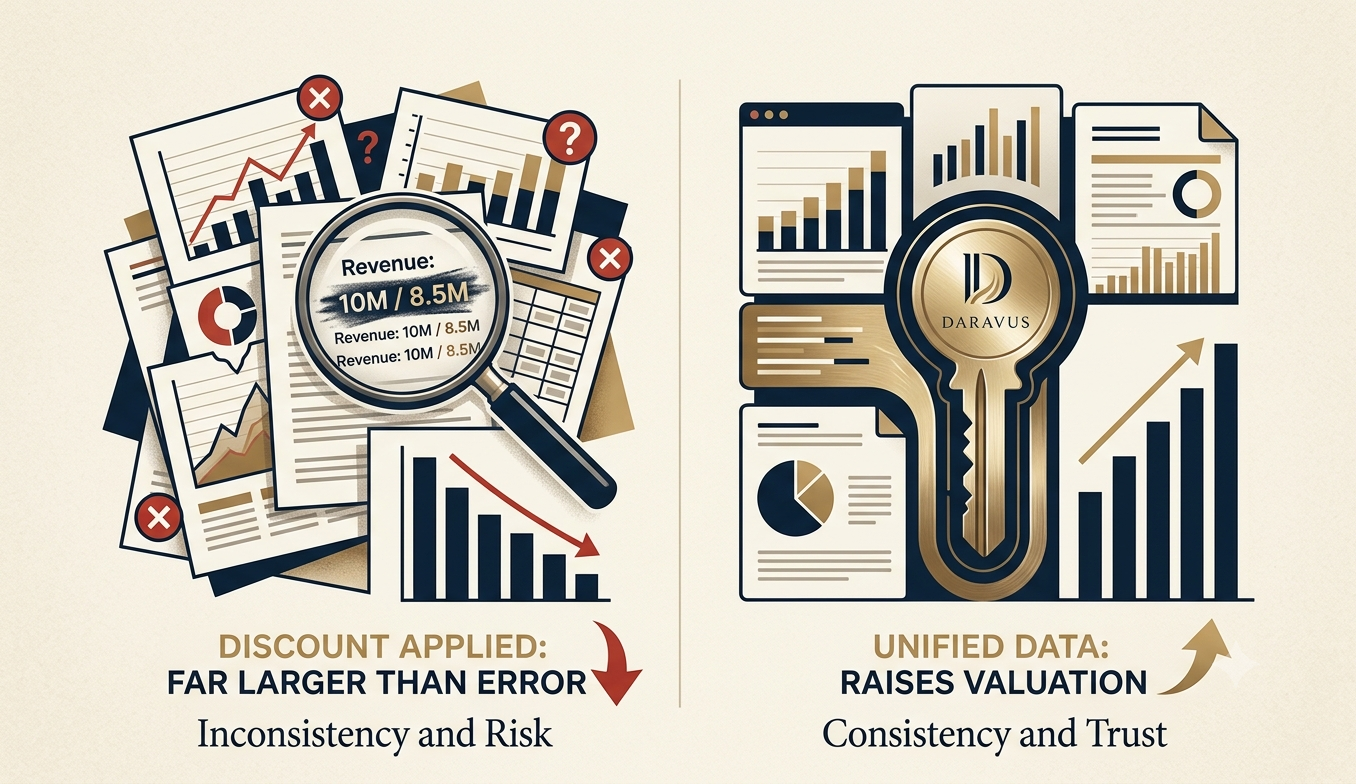
Inconsistency is rarely just a spreadsheet error. It usually signals gaps in process, governance, controls, technology or leadership. That is why the discount applied tends to be far larger than the financial error itself.
Where inconsistencies show up
- Revenue that differs across systems
- Adjusted EBITDA without documentation
- Cash flow incompatible with earnings
- Divergent inventory figures
- Working capital with no explanation
- Different KPIs across different decks
Two companies facing diligence
The same diligence reveals very different companies — not by sophistication, but by the trust the numbers convey.
No single truth
Low trust
- Data diverges across areas and systems
- Adjustments without documentation
- No reconciliations
- Every deck tells a different story
A single truth
High trust
- Integrated ERP, unified data
- Standardized dashboards
- Monthly reconciliations
- Reliable financial planning
The cost of lost trust
When trust drops, the whole process becomes more expensive for the seller.
1
Longer diligence
More requests, more time, more exposure.
2
More guarantees
The investor shifts risk back to the seller.
3
Lower multiples
The uncertainty discount enters the price.
4
Earn-out clauses
Part of the value becomes contingent on the future.
5
Slower negotiations
Every doubt reopens the conversation.
6
Investors who walk
Some simply leave the table.
Conclusion
Mature companies work from a single version of the truth: integrated ERP, consistent metrics and monthly reconciliations.
Governance reduces uncertainty. And trust, in the end, raises valuation.
References
Build numbers an investor can trust.
At Daravus we structure financial governance for companies seeking investment, expansion or M&A.