
M&A
Questions every founder should answer before selling
Before opening a sale process, a few questions set both the price and your leverage.
By Thiago Lucena · Mar 02, 2026 · 7 min read
Many owners believe selling a company begins when a buyer appears. In practice, it begins years earlier.
Valuation reflects perceived risk
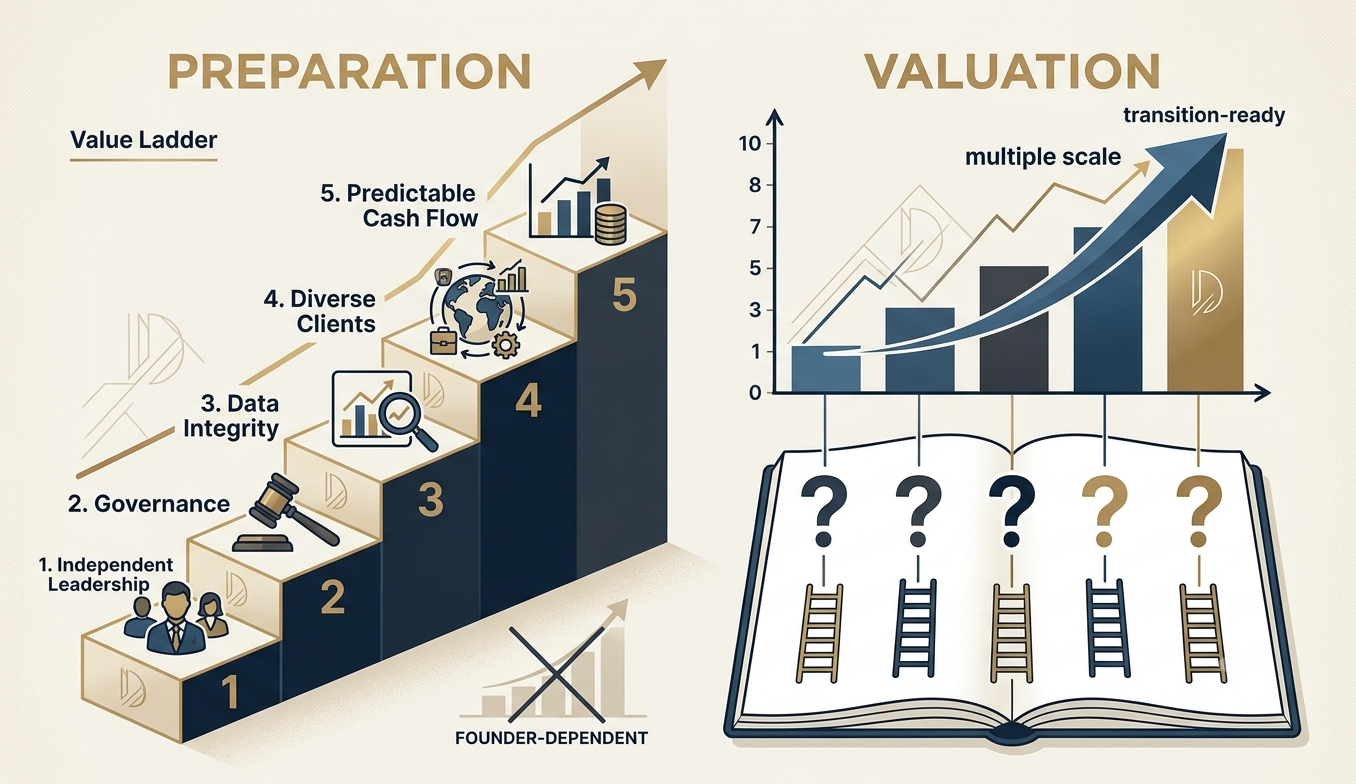
Valuation is not set by revenue or EBITDA alone. It reflects the investor's perception of risk: the lower the perceived risk, the higher the multiple tends to be.
That is why similar companies, in the same sector and with the same revenue, can receive completely different offers.
The highest multiples usually belong to companies that were ready to sell even when they did not want to.
The questions that set the price
Before opening a process, a founder should be able to answer five questions clearly. Each one moves perceived risk — and with it, valuation and negotiating power.
Five questions before selling
- Does your company grow without depending entirely on you?
- Do the numbers tell the same story across P&L, balance sheet and cash flow?
- Is your cash generation sustainable, free of temporary effects?
- Is revenue concentrated in a few clients?
- Is there governance: board, KPIs, controls and compliance?
Two companies, two multiples
The buyer pays less for the risk they see. The gap between one company and another rarely sits in revenue — it sits in dependence and predictability.
Founder-dependent
High risk, low multiple
- The operation depends on the founder to decide
- Numbers diverge across reports
- Cash inflated by temporary effects
- Revenue concentrated in a few clients
Transition-ready
Low risk, high multiple
- Leaders and processes sustain results
- A single version of the truth
- Recurring, predictable cash generation
- A diversified client base
Checklist before starting M&A
What usually separates those who negotiate well from those who accept the first discount.
1
Structured governance
Board, approval limits and internal controls in place.
2
Consistent metrics
KPIs that reconcile across systems and decks.
3
Predictable cash
Recurring generation, no short-term surprises.
4
Diversified revenue
Low dependence on a few clients.
5
Independent leadership
The operation does not stop without the founder.
6
Internal due diligence
Risks mapped before the buyer finds them.
Conclusion
The most common mistake is waiting for the intent to sell before organizing the company. Those who prepare a company to grow usually prepare it to be sold as well.
And those who prepare early negotiate better: they reach the table with numbers that support the narrative and few openings for a discount.
References
Prepare the company before you need to sell.
At Daravus we help founders prepare their companies for fundraising, succession and M&A — maximizing value before the negotiation.